

(Sourced from BCC Global Media / ChosunBiz)
ChosunBiz forum draws some 200 SME CEOs, AI experts; panel urges ‘execute first, refine later’
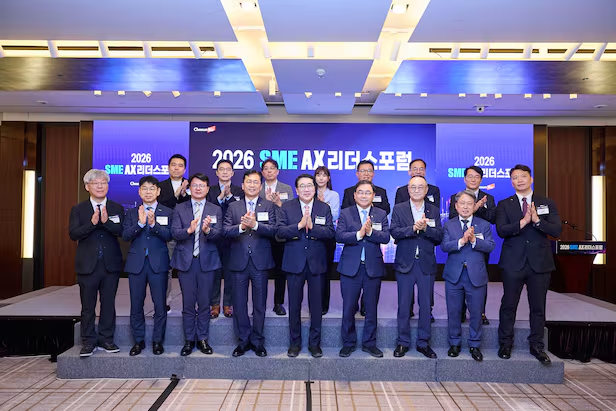
Winston Kim, Head of Korea and Southeast Asia at BCC Global, chaired the closing expert panel at the 2026 SME AX Leaders Forum on Wednesday, leading a discussion on how small and mid-sized enterprises can strengthen competitiveness and expand into global markets in the AI era.
The forum, held at the Westin Josun Seoul in central Seoul, drew some 200 SME chief executives, AI specialists, and government and industry officials. Hosted by ChosunBiz, the economic outlet of the Chosun Media Group, the event was launched last year as Korea’s first forum dedicated to the spread of AI transformation (AX) among SMEs and was held for the second time this year. Under the theme “SME AX Scale-up and the Future of K-Business,” it focused on real adoption results and scale-up strategies. The forum was supported by the Ministry of SMEs and Startups, the Seoul Business Agency (SBA), and the Korea Federation of Micro Enterprise.
ChosunBiz CEO Kim Young-soo delivered the opening address, followed by congratulatory remarks from Rep. Heo Sung-moo of the Democratic Party and Lee Byung-kwon, Second Vice Minister of SMEs and Startups. In a keynote, Professor Kim Chang-hyun of the China Europe International Business School (CEIBS) said “the winners of the AI era will be the companies that design ecosystems, not the lowest-cost producers,” adding that Korea applies AI to internal process optimization while China is re-architecting entire industry value chains. Case presentations from CTK (beauty), Funzin (defense), and CellKey AI (bio) followed.
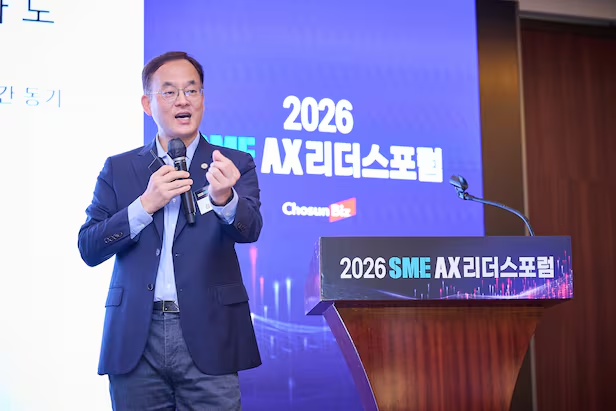
The panel chaired by Kim included Professor Kim Chang-hyun, Cho Hyung-jin, Korea Representative of Kearney; Myung Chang-guk, Executive at LG CNS; Kim Deuk-hwa, CEO of Funzin; and Kwak Jae-kyung, Director of the SME AI Diffusion Team at the Ministry of SMEs and Startups. The discussion opened on how SMEs should respond given that Korea’s AI investment trails that of major economies.
Cho said SMEs should move quickly rather than prepare lengthy AX projects in the manner of large corporations. “By the time such a project is ready, the technology has evolved again,” he said. He described the cost of delay as “experience debt,” saying that “the longer a company puts off adoption, the less AI experience it accumulates, weakening future competitiveness and ultimately affecting corporate value.”
Professor Kim said firms that cannot distinguish automation from AI will struggle to compete, and that processes must be redesigned around AI agents rather than having AI bolted onto existing workflows.

Myung cited data as the decisive factor in Korean manufacturing competitiveness, saying “first data, second data.” He said SMEs must systematically accumulate field-maintenance and production data for AI model training, and advised that “rather than building every system from scratch, SMEs should selectively adopt already-commercialized services.”
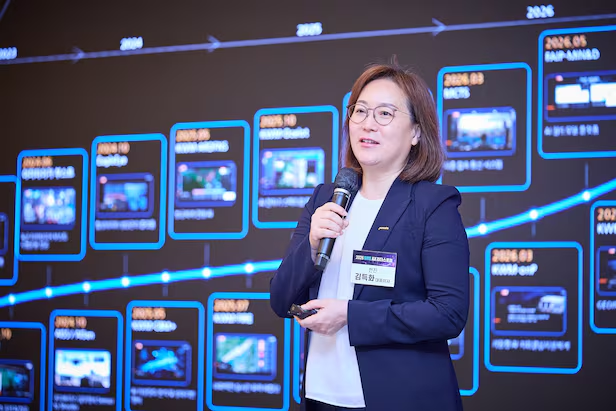
Kim Deuk-hwa said “K-defense must now prepare a second round that incorporates AI,” adding that it is more realistic for SMEs to target business-to-business (B2B) partnerships with defense firms than direct government (B2G) contracts.
Kwak said the government runs tailored training programs for employees, founders, and CEOs, as well as one-on-one outreach education for micro-enterprises, and said it “plans to expand incentives such as tax benefits and restricted stock units (RSUs) over the medium to long term to support the securing of AI talent.” A recurring theme across the forum was the rise of the “Lean AI Native” — companies that use AI agents to deliver large-enterprise-level results with small, elite teams. ChosunBiz also held its inaugural AX Leaders Awards. Taerim Industry received the Minister of SMEs and Startups Award, GenGen AI the ChosunBiz CEO Award, Markcloud the Grand Prize, and CellKey AI the Future Innovation Award.